February 08, 2010
Welcome
 
You are not currently logged in.
What's New at CFEMA
Upcoming Meetings

Updated On: Feb 03, 2010 (00:34:00)


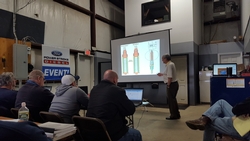
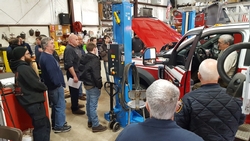
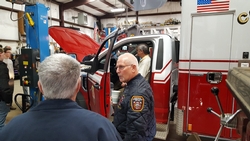
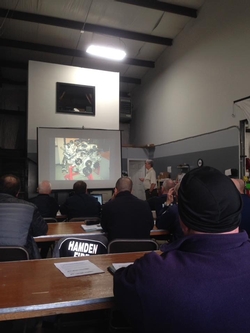
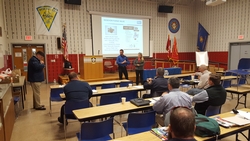
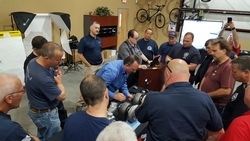
The February meeting will be a night meeting and take place in New Haven. A representative from Cirma will be on hand to discuss Fleet Safety Management. We will also be inviting Department Chiefs to attend as well.

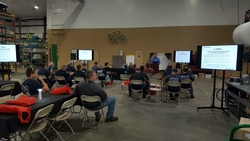
The March meeting will be a day meeting..we are thinking about moving the date to the 24th due to the 17th being a "Holiday"....The meeting is tentatively scheduled to take place at Five Star Fire in East Hartford. There will be a rep from Amkus on hand.....more to follow

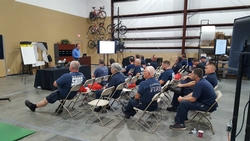
The April meeting will be held in Hartford at the HFD Shop. It will be a night meeting and will cover SCBA maintenance.

The May meeting will be a day meeting....more to follow


Custom, Commercial Chassis in Focus

Posted On: Jan 24, 2010 (18:15:51)

Custom, Commercial Chassis in Focus

Pluses, minuses put into focus at FDSOA.


BY PAUL PELUSO


For the U.S. fire service, custom chassis are as American as apple pie, but with a down economy, that train of thought may change.


That's at least what Rosenbauer America Eastern Regional Sales Manager Sean Duffy is hoping.


Duffy, along with KME Fire Apparatus Nation Account Manager Mark Kopunek, spoke at the FDSOA Apparatus Symposium in Orlando, Fla. Jan. 19 about the differences between custom and commercial chassis.


While the names speak for themselves -- custom models have more available options than their commercial counterparts -- it really all comes down to dollars and cents.


A custom chassis cost between $150,000 to $300,000 while a commercial chassis costs between $90,000 and $225,000.


"They are not inexpensive," Kopunek said; referring to the custom chassis manufacturers such as KME builds. "But they are built for the fire service, which gives departments more options. They have pretty much been the tradition."


Duffy, whose company specializes in commercial chassis, said that if a fire department is in the position to buy a one, it is something that should be looked at.


He also noted that outside of North America, custom chassis are considered foreign.


"There is no such thing as custom chassis in Europe, Asia and other parts of the world," he said, pointing out that some of the biggest cities outside of the U.S. are running the same type of call volume as this country's biggest cities.


One advantage offered by commercial chassis is that parts and service are readily available. Duffy said that not only is it easier to find a larger selection of parts versus custom chassis, most parts and service stations are less than 75 miles away from firehouses in most parts of the U.S.


"Service is more readily available," he said. "You should be able to get the part right then and there."


A drawback to this though, according to Duffy, is that instead of having repairs done at the firehouse, departments must drive the apparatus to the service station.


Another drawback is that there are plenty of limitations commercial chassis have compared to custom chassis.


One is that the life expectancy of a commercial chassis is approximately five to seven years, while custom models can last much longer. Seating also is limited, with commercial models only seating up to five while custom models can seat up to 10.


As far as safety is concerned, custom chassis are NFPA compliant, while commercial models have some limitations. The seat belt lengths, for example, can be an issue. Also, airbags are not available in many commercial chassis.


"It's a big challenge at this point," Duffy said.


There are front and side airbags available on most custom chassis.


It also depends on what setting the fire department is located in. Custom chassis have a much shorter turning radius, which Kopunek says makes it ideal for city driving.


Duffy said that while the differences between commercial and custom chassis are night and day, for some departments they can be a good fit.


"In our current economic climate, you might not have the budget you thought you would. It may be a change from tradition, but when money talks, it's something you need to consider."

Apparatus Driving, Maintenance and Repairs

Updated On: Jan 18, 2010 (19:14:00)
Apparatus Driving, Maintenance and Repairs
  
By HENRY CAMPBELL Senior Correspondent 


Boston Fire Department to Hire Mechanics

Updated On: Jan 17, 2010 (18:43:00)

Boston Fire Department to Hire Mechanics


Boston will hire licensed mechanics to maintain fire trucks after the city and the firefighters’ union reached a settlement.


The agreement comes nearly one year after a firefighter was killed when a fire truck crashed into a building. Investigators determined that the truck's brakes failed, the Boston Globe reported.


The trucks have been maintained by a team of 10 firefighters who are not certified mechanics, the newspaper reported.


The agreement to hire certified mechanics was reached after the firefighters union dropped a demand that the new hires become members of the union, the newspaper said.


In return, the city agreed to some concessions including the dismissal of disciplinary actions pending against some firefighters for their sick leave abuse.


Ford F550 for FD use

Updated On: Dec 08, 2009 (20:06:00)

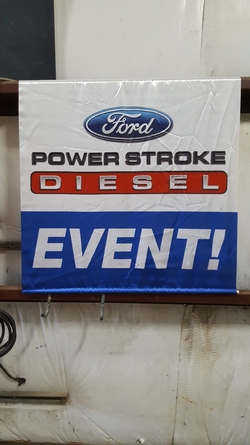
Ford Exhibits New Diesel at L.A. Auto Show


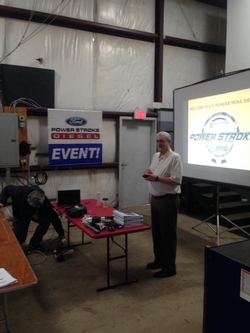
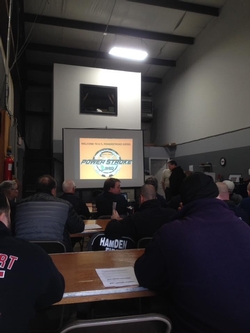
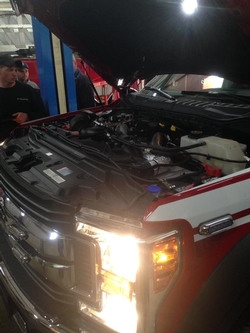
Ford Motor Co. is using the Los Angeles Auto Show this week to showcase a 2011 model of the F-550 Super Duty chassis cab, upfitted as a fire department first-responder vehicle, with the company’s new Power Stroke V-8 diesel engine.


Ford introduced the company-built diesel earlier this year. The engine will replace the current model, built by Navistar International Corp., beginning next year in 2011 model-year trucks.


Ford decided to develop and build the engine after disputes with Navistar over warranty costs and payments led to a mutual agreement to end the 27-year relationship after Dec. 31.


The fire truck also served as a vehicle to attract donations to the Los Angeles County Firefighters Widows and Orphans Fund, Ford said. The company made a cash donation and said it would add to the fund depending on the number of people who visited the display or tested a vehicle.


The new engine features a compacted graphite iron block, a dual mode turbocharger, more power and torque, and can run on biodiesel blends of up to B20


Slack Adjusters

Updated On: Dec 03, 2009 (18:37:00)

Manual Adjustment of Automatic Slack Adjusters May Contribute to Unexpected Brake Failure on Automotive Fire Apparatus


National Institute for Occupational Safety and Health


Photo NIOSH
An automatic slack adjuster is seen in this handout photo.


Photo NIOSH
The automatic slack adjuster is seen as a component of the foundation brakes.

NIOSH recommends that all fire departments operating fire apparatus equipped with automatic slack adjusters (ASAs) immediately take the following actions to reduce the risk of fire fighters being injured in an apparatus crash due to brake failure:

• Ensure that ASAs are not manually adjusted.

• Establish procedures to ensure maintenance on fire apparatus is conducted as recommended in NFPA 1911 Standard for the Inspection, Maintenance, Testing, and Retirement of In-Service Automotive Fire Apparatus.

• Ensure maintenance is only performed by qualified technicians who meet NFPA 1071 Standard for Emergency Vehicle Technician Professional Qualifications.

An automatic slack adjuster is a mechanical component of the air brake system that adjust brakes as necessary when the vehicle is in operation to compensate for wear in the brake shoes (drum brakes) or pads (disc brakes). When an ASA is found to be out of adjustment, it signifies the existence of a larger braking system problem that needs correction. Manual adjustment of ASAs should only be done by qualified technicians during installation or when absolutely necessary to move the apparatus to a repair facility (NTSB 2006, 2007; IAFC 2006).

In 2006, the International Association of Fire Chiefs (IAFC) warned the fire service of this potential problem (IAFC 2006) following an investigative report released by the National Transportation Safety Board (NTSB 2006). While conducting an investigation of a recent apparatus crash-related fire fighter fatality, NIOSH learned that fire departments may not fully appreciate the hazards related to manual adjustment of ASAs. NIOSH would like to renew efforts to bring this to the attention of all U.S. fire departments, fire fighters, and fleet maintenance departments who are tasked with preventive maintenance or operation of apparatus equipped with ASAs. The manual adjustment of ASAs may contribute to unexpected brake failure on fire apparatus. When an ASA is found to be out of adjustment it signifies the existence of a larger problem with the braking system that needs to be corrected immediately. Vehicles found to have ASAs that are out of adjustment should be taken out-of-service immediately until corrective brake service is completed.

Fire Departments should ensure that all technicians conducting brake service on fire department apparatus: (1) are certified in air brake repair to the level (T-4) required by the Automotive Service Excellence Medium/Heavy Duty Truck Technician Certification and (2) have, at a minimum, Level 1 Fire Apparatus Technician Certification as certified by the Emergency Vehicle Technician Certification Commission. Additionally, fire departments should adhere to manufacturer guidelines and recommendations and applicable federal, state or provincial, and local laws regarding apparatus inspection and maintenance [NFPA1911].

Further, the NTSB has recommended, and NIOSH agrees, that all drivers of fire apparatus equipped with air brakes must undergo training and testing to demonstrate proficiency in the inspection and operation of air-braked vehicles. Such training should emphasize that manual adjustment of automatic slack adjusters is dangerous and should not be done, except during installation, or in an emergency situation when it is absolutely necessary to move the vehicle to a repair facility.

References
IAFC [2006]. Lessons learned from a fatal crash: Truck air brake warning: Manually adjusting automatic slack adjusters is dangerous, can lead to deadly consequences. Fairfax, VA: International Association of Fire Chiefs, Article on Website. Date accessed: September 2009. http://www.iafc.org/displayindustryarticle.cfm?articlenbr=30820.

NFPA [2006]. NFPA 1071 Standard for emergency vehicle technician professional qualifications. 2006 ed. Quincy, MA: National Fire Protection Association.

NFPA [2007]. NFPA 1911 Standard for the inspection, maintenance, testing, and retirement of in-service automotive fire apparatus. 2007 ed. Quincy, MA: National Fire Protection Association.

NTSB [2006]. Collision between a Ford dump truck and four passenger cars, Glen Rock, PA, April 11, 2003. Washington, DC: National Transportation Safety Board, NTSB Report Number HAR-06/01.

NTSB [2007]. Facts on truck brake maintenance: Dangers of manually adjusting slack adjusters. Washington, DC: National Transportation Safety Board, August.


UPDATE   12/3/09

NIOSH Issues Slack-Adjuster Advisory


The National Institute for Occupational Safety and Health recommends that all fire departments operating apparatus equipped with automatic slack adjusters (ASAs) immediately take the following actions to reduce the risk of firefighters being injured in an apparatus crash due to brake failure:

  • Ensure that ASAs are not manually adjusted. 
  • Establish procedures to ensure maintenance on fire apparatus is conducted as recommended in NFPA 1911, Inspection, Maintenance, Testing, and Retirement of In-Service Automotive Fire Apparatus. 
  • Ensure maintenance is only performed by qualified technicians who meet NFPA 1071, Emergency Vehicle Technician Professional Qualifications. 


An automatic slack adjuster is a mechanical component of the air-brake system that adjusts brakes as necessary when the vehicle is in operation to compensate for wear in the brake shoes (drum brakes) or pads (disc brakes). When an ASA is found to be out of adjustment, it signifies the existence of a larger braking system problem that needs correction. Manual adjustment of ASAs should only be done by qualified technicians during installation or when absolutely necessary to move the apparatus to a repair facility.


In 2006, the International Association of Fire Chiefs warned the fire service of this potential problem following an investigative report released by the National Transportation Safety Board. While conducting an investigation of a recent apparatus crash-related firefighter fatality, NIOSH learned that fire departments may not fully appreciate the hazards related to manual adjustment of ASAs. NIOSH would like to renew efforts to bring this to the attention of all U.S. fire departments, firefighters, and fleet-maintenance departments who are tasked with preventive maintenance or operation of apparatus equipped with ASAs. The manual adjustment of ASAs may contribute to unexpected brake failure on fire apparatus. When an ASA is found to be out of adjustment it signifies the existence of a larger problem with the braking system that needs to be corrected immediately. Vehicles found to have ASAs that are out of adjustment should be taken out-of-service immediately until corrective brake service is completed.

Further, the NTSB has recommended, and NIOSH agrees, that all drivers of fire apparatus equipped with air brakes must undergo training and testing to demonstrate proficiency in the inspection and operation of air-braked vehicles. Such training should emphasize that manual adjustment of automatic slack adjusters is dangerous and should not be done, except during installation, or in an emergency situation when it is absolutely necessary to move the vehicle to a repair facility.

ANNOUNCEMENTS

2010 DUES ARE NOW DUE


3373 visitors since Jan 01, 2008
Member Login
Username:

Password:


Not registered yet?
Click Here to sign-up.

Forgot Your Login?
Action Center
<<  February 2010  >>
S M T W T F S
1 2 3 4 5 6
7 8 9 10 11 12 13
14 15 16 17 18 19 20
21 22 23 24 25 26 27
28
Important Links
Ct Fire Apparatus
Ct Fire
Northern California Fire Mechanics Association
Arizona Fire Service Mechanics Association
National Association Of Emergency Vehicle Technicians
Oklahoma Association Of Emergency Vehicle Tech.
California Fire Mechanics Academy
Wisconsin Assoc of EVT's
ASE Certification
Washington Fire Mechanics Assoc.
Oregon Fire Apparatus & Equipment Mechanics assoc.
Ohio Assoc of EVT's
Heartland EVT's
Illonois Fire Apparatus Mechanics Assoc
New England FAMA
Emergency Vehicle Technician Certification program
Colorado Fire Mechanic's Association
Long Island Assn Of Emergency Vehicle Tech.
Google
Weather Report

 OUR CORPORATE MEMBERS

 Please check the members area to the left for links to the websites for these sponsors  

  • On Spot Automatic Snow Chains
  • Five Star Fire
  • Camerota Truck Parts
  • E.J. Boughton Co.
  • Gowans & Knight
  • Firematic Supply
  • Firstline Emergency Services
  • Fleetmasters
  • Kussmaul Electronics
  • Northeast Fire Associates
  • Rogers Repair
  • Twin Lights Apparatus Repair Div.
  • Nichols Fire Apparatus
  • St. Pierre of Ct. Tire Chains
  • Top Rung Inspection & Testing LLC
  • New England Fire Equipment & Apparatus Corp
  • DPF Regeneration
  • Transaxle
  • Greenwood Emergency Vehicles


Visit Unions-America.com!
 Top of Page © Copyright 2010, Connecticut Fire Equipment Mechanics Association, All Rights Reserved.
Powered By UnionActive™
Hide the Right Hand Column